Launch offer — valid today only

Canada's Basic Amateur Radio Exam, One Drawing per Concept With Every Concept Drawn Step by Step!

Made for ISED's Basic Qualification and the question bank in use since July 15, 2025, with Canadian rules. Bands, call signs, Ohm's law, antennas and propagation: each topic on one page, with the drawing and what you need to remember. 69 illustrated pages.

SHOW ME THE DRAWN PAGES

🔒 Secure checkout · PDF by email · 30-day guarantee

One topic per pageOne topic per page: the drawing first, the key numbers in boxes
69 illustrated pages9 parts: the exam itself, then ISED's 8 question-bank sections
Up-to-date sourcesISED's RIC-3, RBR-4 and the Basic formula sheet (May 2025)

This Is What the Pages You Will Study Look Like

One topic per page, the drawing that shows you how it works and the boxes with what you need to know:

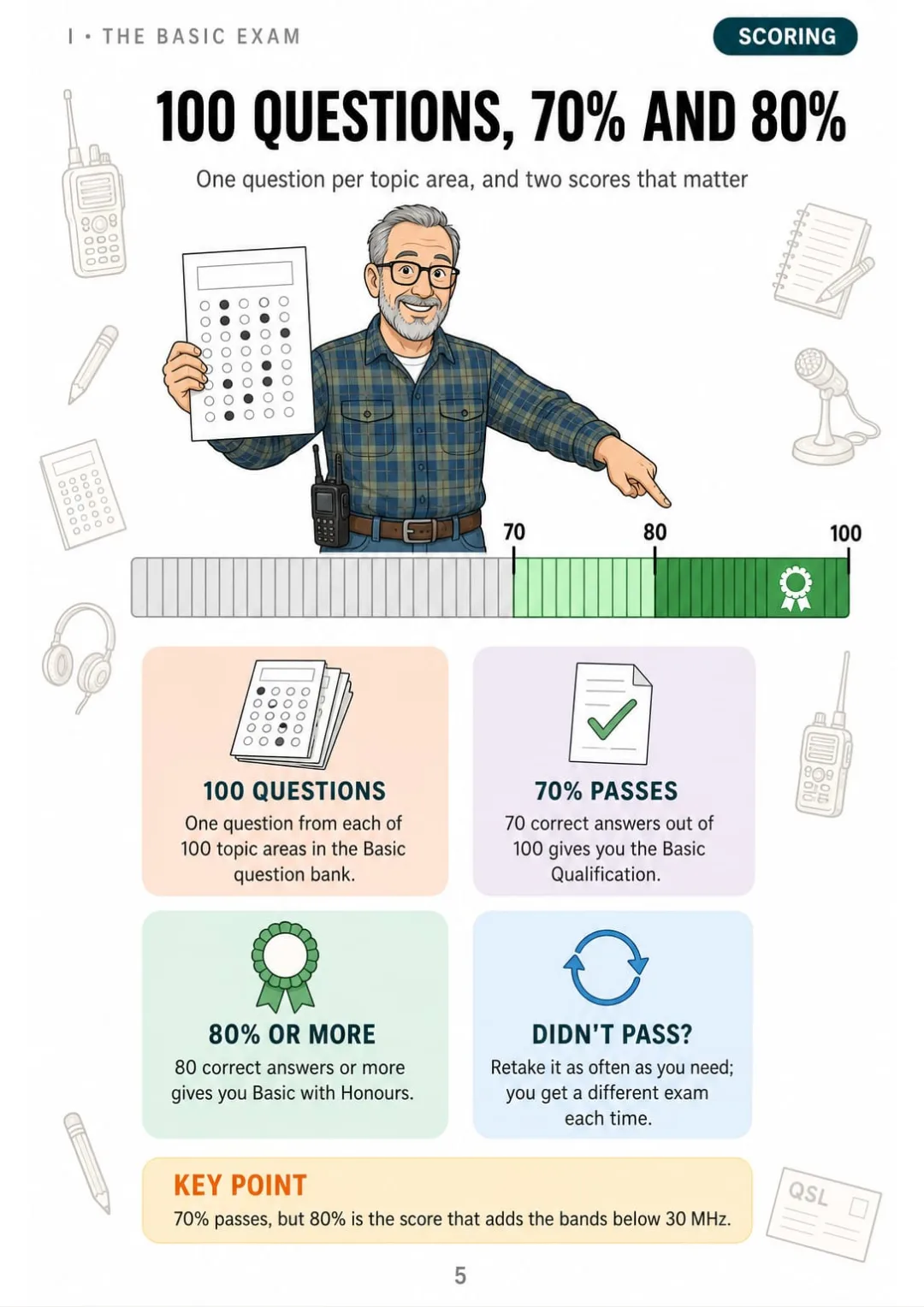
100 questions, one per topic area: 70% passes, 80% or more gives Basic with Honours.
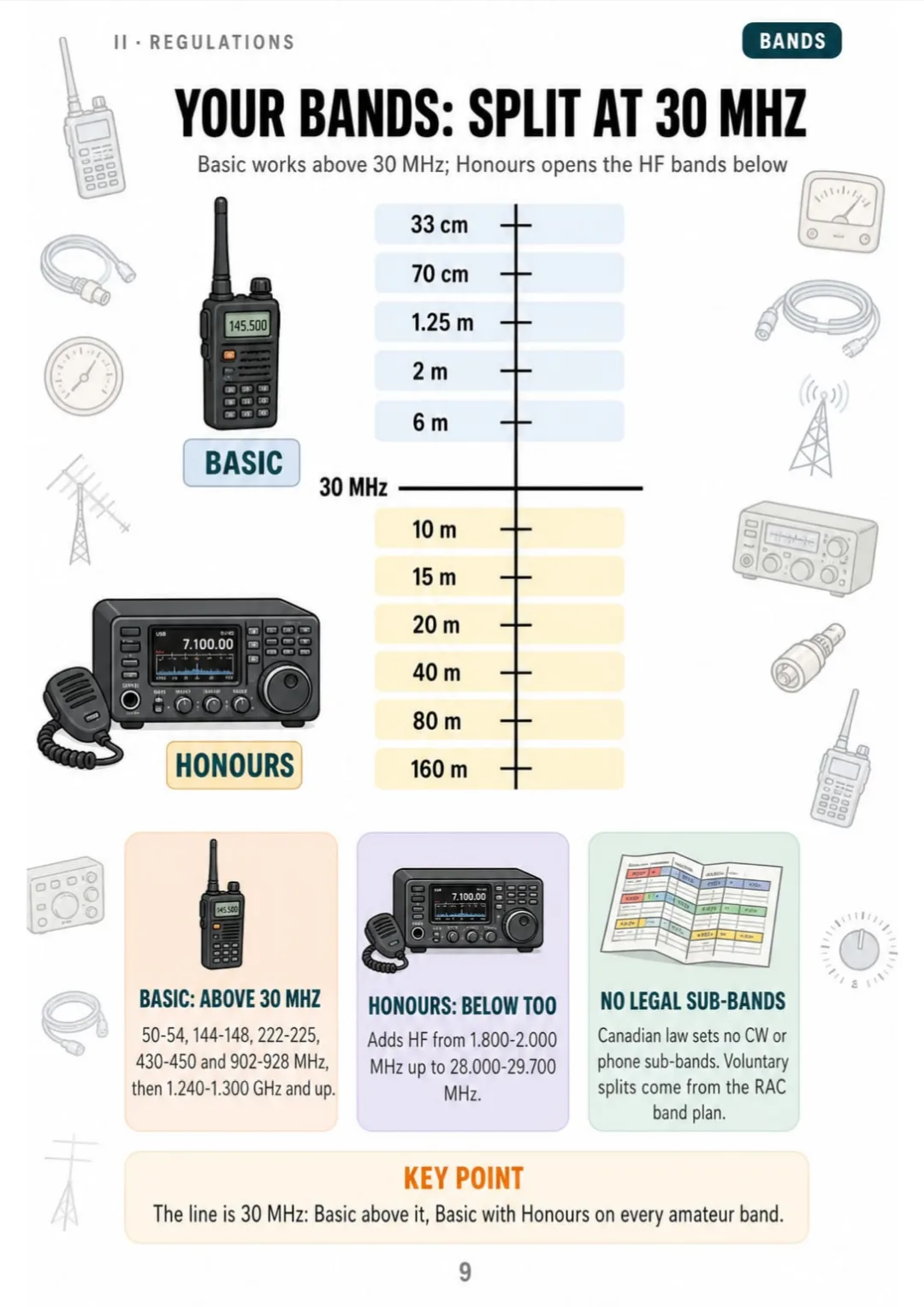
Basic: above 30 MHz (50, 144, 222, 430, 902 MHz…) · Honours adds 1.8 to 29.7 MHz
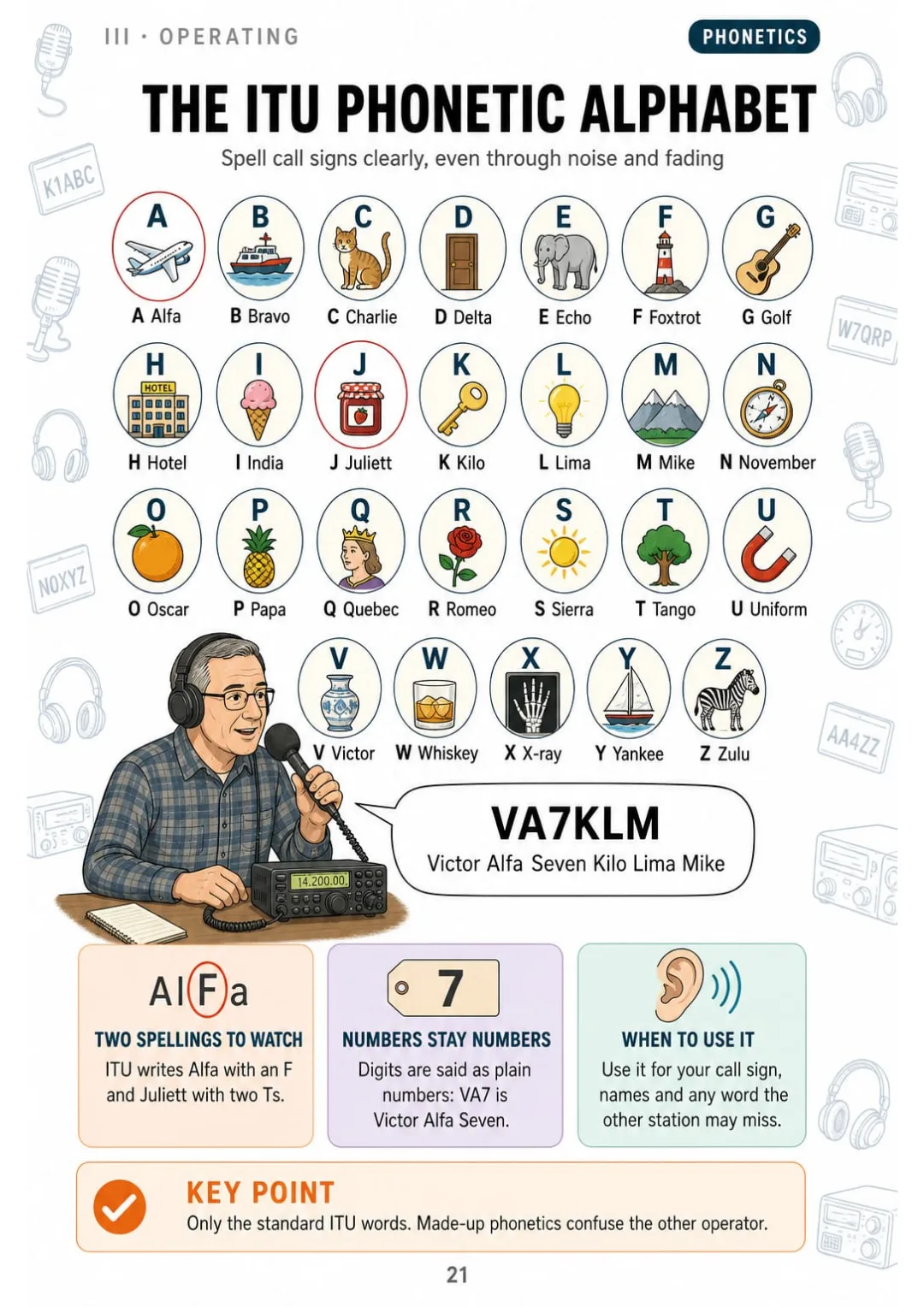
26 ITU words as icons: VA7KLM said as Victor Alfa Seven Kilo Lima Mike.
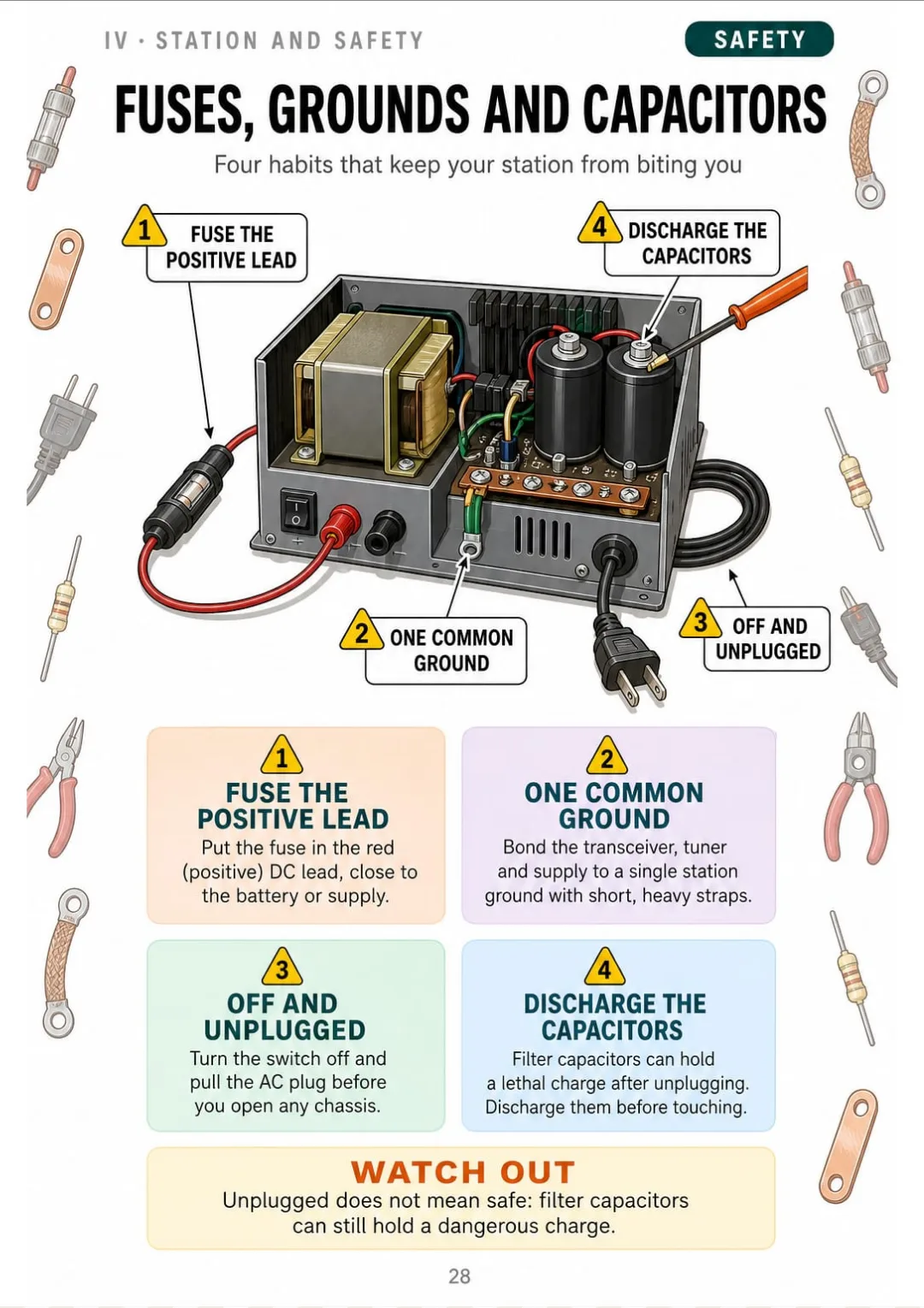
Fuse on the positive lead, one common ground, unplug, then discharge the capacitors.
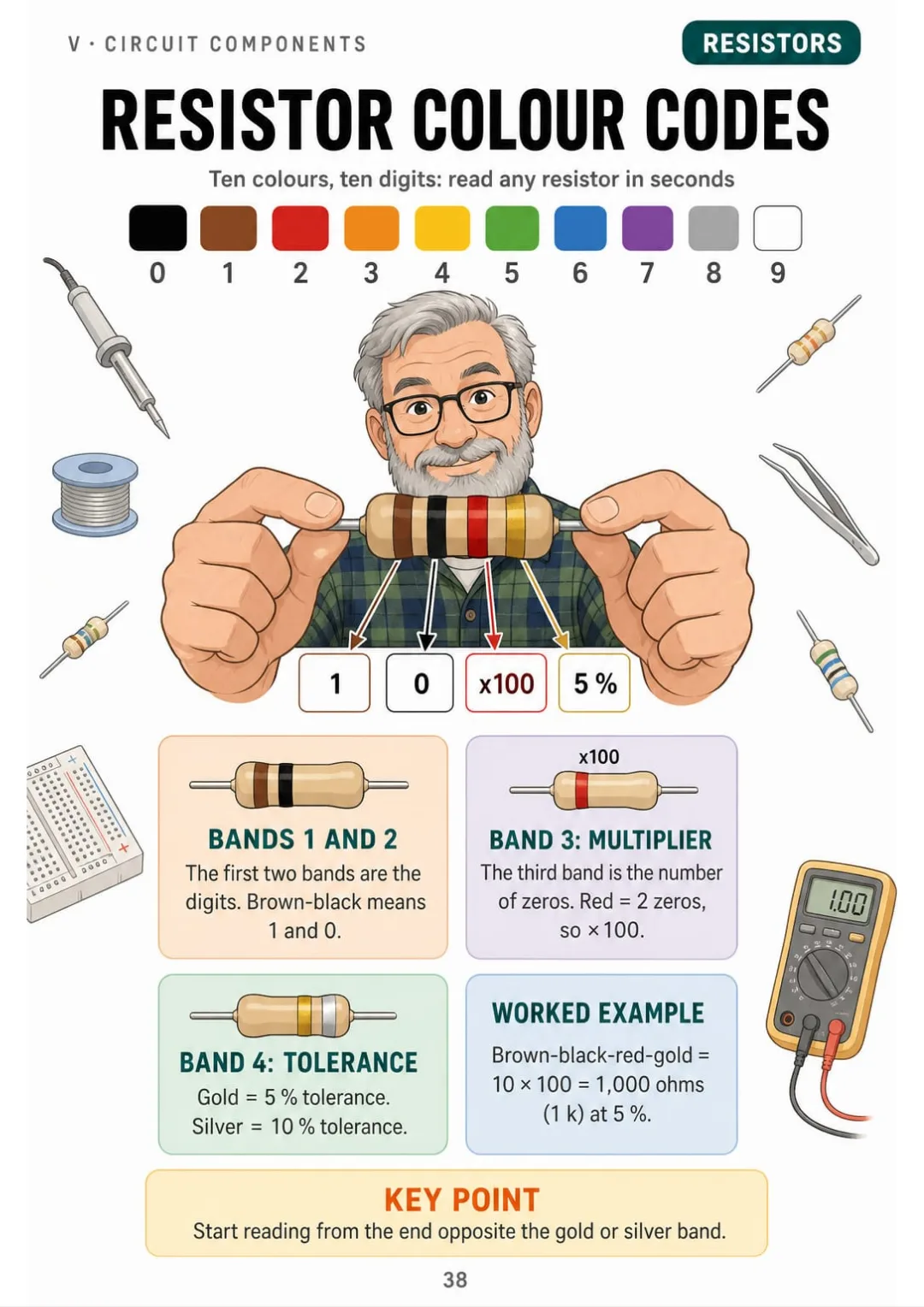
Black 0 to white 9: brown-black-red-gold = 1 k at 5 %.
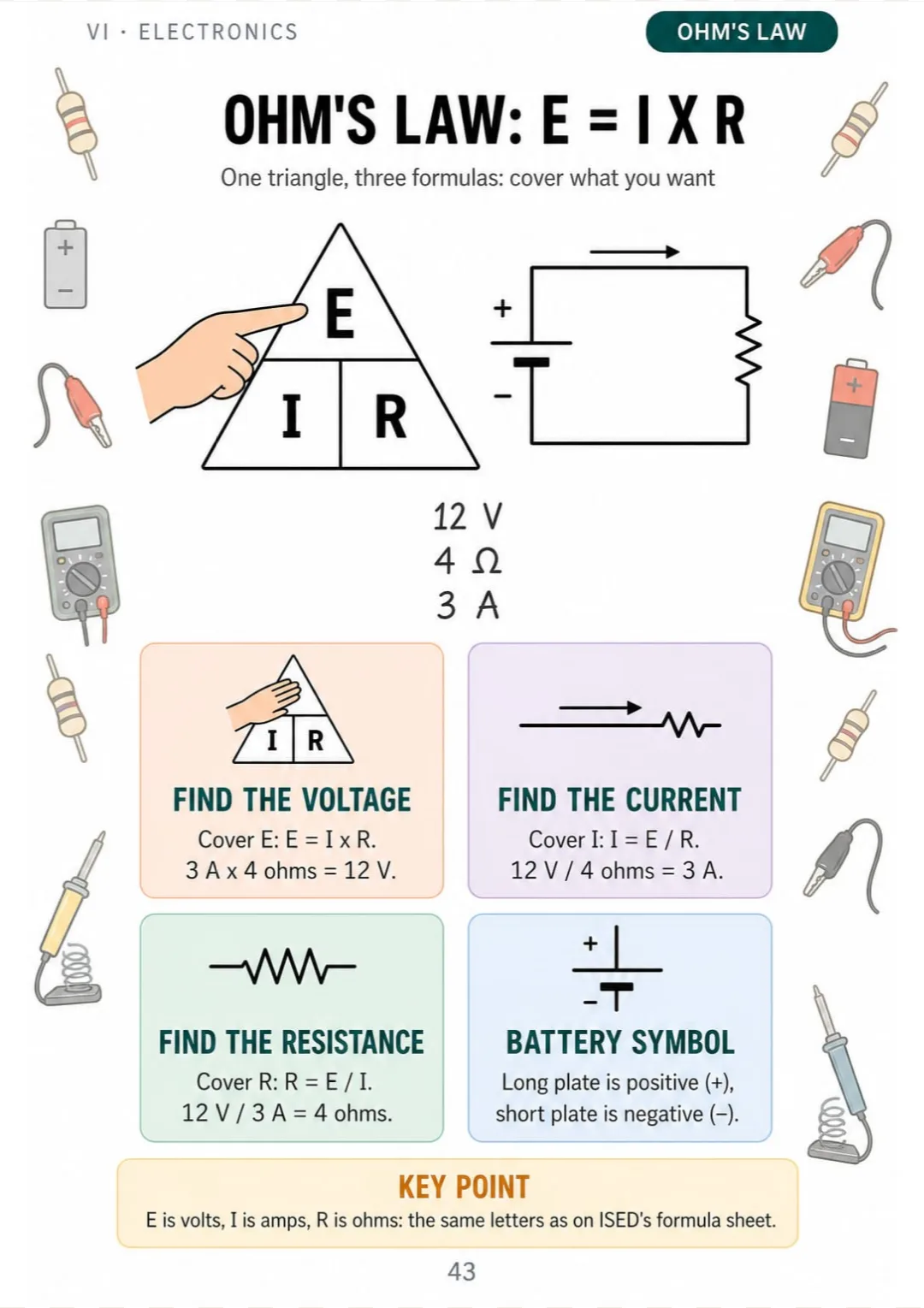
12 V across 4 ohms = 3 A, and 12 V / 3 A gives back 4 ohms
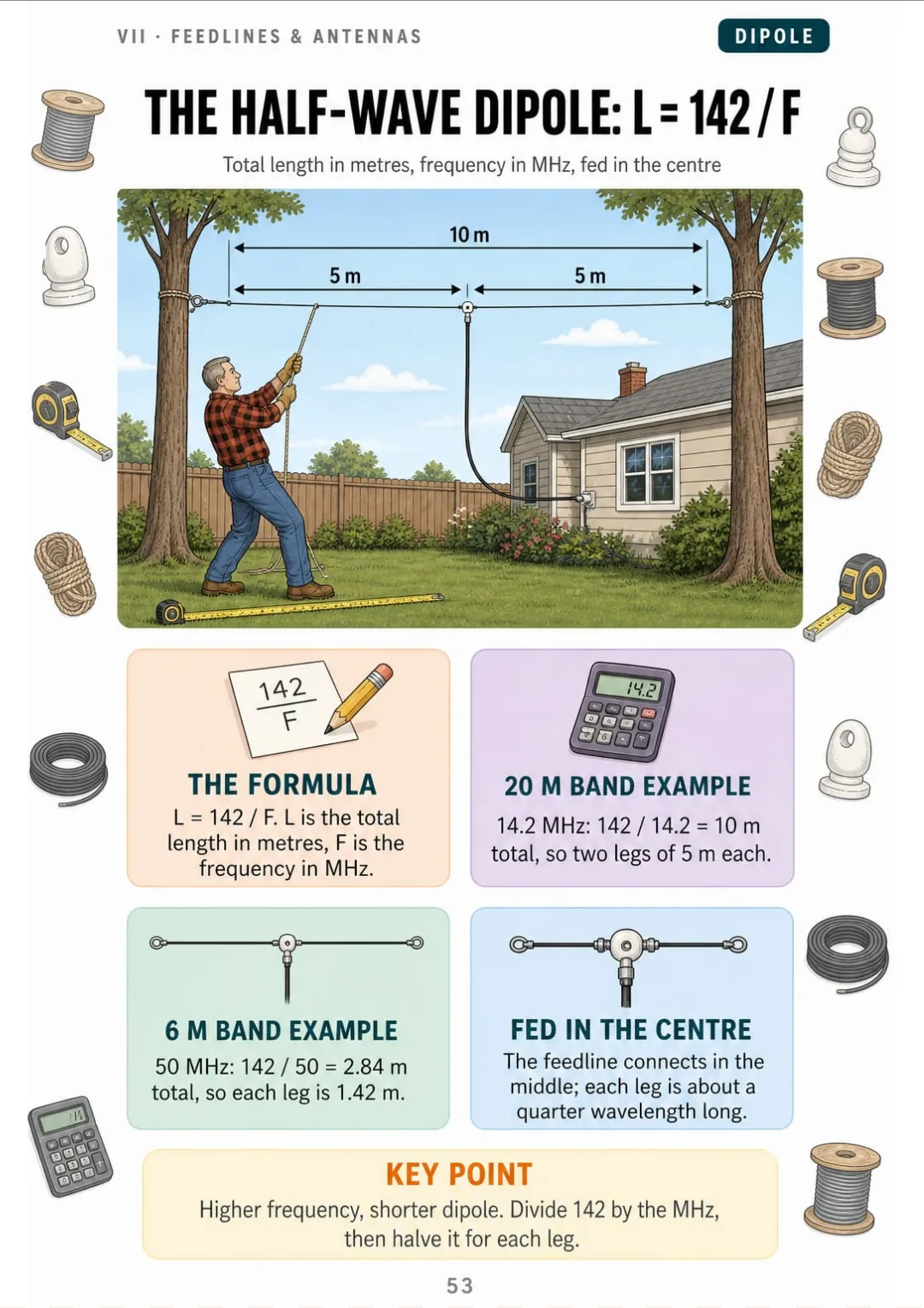
Half-wave dipole: L = 142 / F — 14.2 MHz gives 10 m, two 5 m legs.
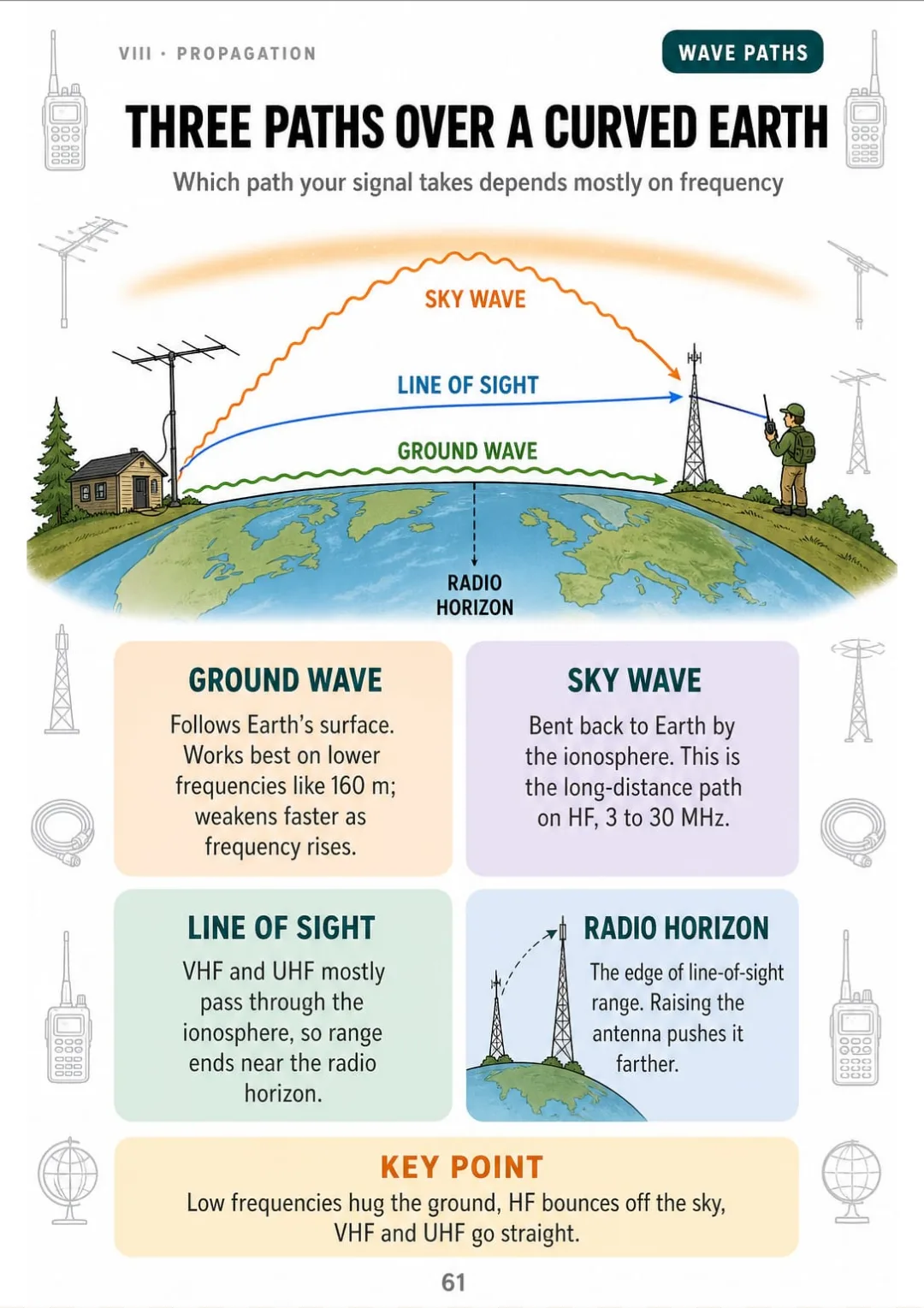
Ground wave on low bands, sky wave on HF, line of sight on VHF and UHF.

Swipe to see more →

These are real pages from the book. The table of contents is the full one: 9 parts and 65 topics.

Nobody Put It in Order. Here It Is, One Drawing per Topic.

You've read the phonetic alphabet three times. You close the book...

...and you can't say your own call sign without stopping at every letter. It was just a column of 26 words.

26 ITU words as icons: VA7KLM said as Victor Alfa Seven Kilo Lima Mike.

Here the alphabet is one page, each word drawn as an icon: VA7KLM becomes Victor Alfa Seven Kilo Lima Mike.

And the pages around it do the same for station identification, repeaters, Q signals and RST reports.

First you understand why it's done that way. Then it comes back to you, in order.

SEE THE DIFFERENCE

Stop Memorizing Band Limits You Can't Picture:

THIS
  • Pages and pages of cramped text
  • Bands and limits without a single drawing
  • On exam day, you don't know where to start
Pursuant to the Radiocommunication Regulations and RBR-4, holders of the Basic Qualification may operate on all amateur frequency bands above 30 MHz, including 50–54 MHz, 144–148 MHz, 222–225 MHz, 430–450 MHz and 902–928 MHz, subject to the applicable bandwidth limits. Holders of the Basic Qualification with Honours (a mark of 80% or more) or of the Morse code qualification are additionally authorized to operate on the bands below 30 MHz, namely 1.800–2.000 MHz, 3.500–4.000 MHz, 7.000–7.300 MHz and the remaining HF allocations up to 29.7 MHz.
FOR THIS
  • Every band drawn on one scale
  • One topic per page, with the rules in boxes
  • You remember it because you've seen it
Basic: above 30 MHz (50, 144, 222, 430, 902 MHz…) · Honours adds 1.8 to 29.7 MHz
CONTENTS

Take a Look at the 9 Parts and 65 Topics

The exam, regulations, operating, station and safety, components, electronics, antennas, propagation and interference: 69 pages, 65 topics, each one drawn

IThe Basic Exam · pp. 5-8
  1. The Basic Exam: 100 Questions, 70 % and 80 %
  2. The 8 Sections of the Question Bank on One Map
  3. What Basic, Honours, Advanced and Morse Unlock
  4. Exam Day: Accredited Examiner, Photo ID and the Formula Sheet
IIRegulations and Policies · pp. 9-20
  1. Your Bands: Basic Above 30 MHz, Honours Below
  2. Who Makes the Rules: the Act, the Regulations and RBR-4
  3. Your Certificate, Your Call Sign and the Canadian Prefixes
  4. Station Identification: Start, End and Every 30 Minutes
  5. What You Can't Send: Music, Secret Codes, Profanity, Business
  6. Basic Power Limits: 250 W DC Input
  7. Maximum Bandwidth, Band by Band
  8. Interference: Amateurs Give Way
  9. Emergencies and Contact with Non-Amateur Stations
  10. Visitors, Third Parties and Operating Abroad
  11. What Basic Lets You Build, Program and Operate
  12. Antenna Structures, Neighbours and Your Address
IIIOperating and Procedures · pp. 21-27
  1. The ITU Phonetic Alphabet
  2. Repeaters: Offset, Tone and Courtesy
  3. Simplex and HF Voice Contacts
  4. Tune-Ups and the Dummy Load
  5. CW Procedure Signs and Q Signals
  6. RST Reports and the S Meter
  7. Emergency Traffic and Keeping a Log
IVStation Assembly, Practice and Safety · pp. 28-37
  1. Electrical Safety: Fuses, Grounds and Capacitors
  2. A Typical HF Station, Block by Block
  3. The FM Transmitter and the FM Receiver
  4. The CW Transmitter and the SSB Transmitter
  5. The Superheterodyne Receiver
  6. AM, SSB and FM: How Your Voice Rides the Carrier
  7. Digital Modes: From RTTY to Today
  8. Batteries and the Regulated Power Supply
  9. Antenna, Tower and Lightning Safety
  10. RF Exposure: Distance, Power and Time
VCircuit Components · pp. 38-42
  1. Resistor Colour Codes
  2. Diodes: One-Way Valves for Current
  3. Bipolar Transistors: NPN and PNP
  4. Field-Effect Transistors and the Triode Tube
  5. Amplifiers: Small Signal In, Big Signal Out
VIBasic Electronics and Theory · pp. 43-52
  1. Ohm's Law: E = I x R
  2. Metric Prefixes: Pico to Giga
  3. Current, Voltage, Conductors and Insulators
  4. Series and Parallel Resistors
  5. Power: P = I x E
  6. AC, Sine Waves and Frequency
  7. Decibels and Power Ratios
  8. Inductors, Capacitors, Reactance and Impedance
  9. Transformers and Resonant Circuits
  10. Meters and Measurements
VIIFeedlines and Antenna Systems · pp. 53-60
  1. The Half-Wave Dipole: L = 142 / F
  2. Wavelength and Frequency: 300 / F
  3. Coax, Ladder Line and Baluns
  4. Line Loss and Connectors
  5. SWR and Impedance Matching
  6. Polarization, Gain and Radiation Patterns
  7. The Quarter-Wave Vertical: L = 71 / F
  8. The Yagi-Uda and the Quad Loop
VIIIRadio Wave Propagation · pp. 61-65
  1. Ground Wave, Sky Wave and Line of Sight
  2. The Ionosphere: D, E and F Layers
  3. Skip Zone and Skip Distance
  4. Sunspots, Solar Flux and the MUF
  5. VHF and UHF: Sporadic-E, Aurora, Ducting and Scatter
IXInterference and Suppression · pp. 66-69
  1. Front-End Overload and Cross-Modulation
  2. Audio Rectification: Bypass Capacitors and Ferrites
  3. Harmonics, Splatter and Key Clicks
  4. Filters: Low-Pass, High-Pass, Band-Pass, Band-Reject

What If Every Topic Fit on a Single Page?

Picture this:

Instead of rereading half a page about the ionosphere without being able to see it...

...you open the page and find the D, E and F layers stacked over the Earth, each with what it does by day and by night.

Black 0 to white 9: brown-black-red-gold = 1 k at 5 %.

And your bands, Ohm's law, the dipole, SWR and the superheterodyne receiver turn into drawings and tables you read at a glance.

You stop repeating and start understanding.

That's exactly what The Amateur Radio Basic Sketchbook does. It's not “just another manual.” It's 9 parts and 65 drawn topics, in the order of ISED's 8 question-bank sections. Because what your brain sees in order, it remembers.

Because what your brain sees organized, it remembers.

Here Is What You Get with The Amateur Radio Basic Sketchbook:

Ipp. 5-8

The Basic Exam

How the 100-question exam works, 70% and 80%, the 8 sections on one map, what each qualification unlocks and what to bring on exam day.

IIpp. 9-20

Regulations and Policies

Your bands split at 30 MHz, who makes the rules, call signs and prefixes, station ID, what you can't send, power and bandwidth limits, interference, emergencies, third parties and antenna structures.

IIIpp. 21-27

Operating and Procedures

The ITU phonetic alphabet, repeater offset and tone, simplex and HF contacts, the dummy load, CW prosigns and Q signals, RST reports and keeping a log.

IVpp. 28-37

Station Assembly, Practice and Safety

Electrical safety, a typical HF station block by block, FM, CW and SSB transmitters, the superheterodyne receiver, AM, SSB and FM, digital modes, power supplies, tower and lightning safety, and RF exposure.

Vpp. 38-42

Circuit Components

Resistor colour codes, diodes, NPN and PNP transistors, FETs and the triode, and how an amplifier turns a small signal into a big one.

VIpp. 43-52

Basic Electronics and Theory

Ohm's law, metric prefixes, conductors and insulators, series and parallel, power, AC and frequency, decibels, reactance and impedance, transformers, resonance and meters.

VIIpp. 53-60

Feedlines and Antenna Systems

The half-wave dipole with 142 / F, wavelength with 300 / F, coax and baluns, line loss, SWR, gain and patterns, the quarter-wave vertical, the Yagi and the quad.

VIIIpp. 61-65

Radio Wave Propagation

Ground wave, sky wave and line of sight, the D, E and F layers, skip zone, sunspots and the MUF, and VHF openings like sporadic-E and ducting.

IXpp. 66-69

Interference and Suppression

Front-end overload, audio rectification, harmonics and key clicks, and the four filters drawn side by side.


And That Is Not All: 2 More Books, Free

Canadian Amateur Band Chart, Printable

BONUS 1: «Canadian Amateur Band Chart, Printable»

Value on its own: CA$ 24.99

Every Canadian amateur band from RBR-4 Schedule I on one wall chart, marked Basic or Honours, with its maximum bandwidth, plus a pocket version for review.

250 Basic Qualification Terms on Cards

BONUS 2: «250 Basic Qualification Terms on Cards»

Value on its own: CA$ 19.99

Practise the vocabulary of the exam with printable cards: the term on the front, a one-line definition and a tiny sketch on the back (SWR, MUF, CTCSS, simplex, balun…).

The Amateur Radio Basic Sketchbook + 2 Free Books

  • The Amateur Radio Basic Sketchbook: 69 illustrated pagesCA$ 79.99
  • BONUS 1: Canadian Amateur Band Chart, PrintableCA$ 24.99
  • BONUS 2: 250 Basic Qualification Terms on CardsCA$ 19.99
  • High-resolution PDF to printIncluded
Total value CA$ 124.97
YOUR PRICE:
CA$ 34.99
You save CA$ 89.98
YES, I WANT THE AMATEUR RADIO BASIC SKETCHBOOK FOR CA$ 34.99

📄 This is a digital PDF book sent to your email: nothing is printed or shipped.

Secure purchaseEncrypted payment30-day guarantee

PDF by email: The Amateur Radio Basic Sketchbook reaches your inbox as a PDF, and the two free books come by email too. One-time payment, no installments or hidden costs.

Is This Book for You?

You're studying for your first certificate

You're studying for your first certificate

Every topic of the Basic exam on its own page, in the order of ISED's 8 sections, to review in short sessions between everything else.

Your exam date is set

Your exam date is set

A review of all 65 topics before you sit with the accredited examiner, plus the band chart and 250 term cards to drill the vocabulary. If you're aiming for 80% and HF, no section is left out.

You already have your call sign

You already have your call sign

A quick visual refresher on what you use on the air: repeater offset and tone, SWR, the dipole formula and the HF bands if you go back for Honours.

To Sum Up: Here Is What You Get

CA$ 124.97CA$ 34.99
YES, I WANT THE AMATEUR RADIO BASIC SKETCHBOOK FOR CA$ 34.99

📄 This is a digital PDF book sent to your email: nothing is printed or shipped.

30DAYS
GUARANTEE

30-Day Guarantee

30-day guarantee: tell us what didn't work and we'll refund 100%.

You have 30 days to try The Amateur Radio Basic Sketchbook and the two bonus books. If it doesn't work for you, tell us what didn't work and we'll refund 100% of what you paid. One-time payment, no subscription.

Frequently Asked Questions

How do I get the material?

After your purchase you get The Amateur Radio Basic Sketchbook as a high-resolution PDF, sent to the email you enter at checkout. Read it on your phone, tablet or computer, or print it. The two bonus books, Canadian Amateur Band Chart, Printable and 250 Basic Qualification Terms on Cards, come the same way, as PDFs by email.

Is it a monthly or a one-time payment?

A one-time payment in Canadian dollars (CAD). No installments, no subscription.

Who is it for?

For anyone in Canada preparing for ISED's Basic Qualification exam: a first try, a retake after falling short of 70%, or aiming for 80% and Honours. No math or electronics background needed: every formula comes with a worked example in real numbers, step by step. It covers Canadian rules only. It follows ISED's Canadian question bank and the Canadian bands. It doesn't cover the Advanced or Morse code qualifications.

What sources is it based on?

On ISED's RIC-3 (Issue 5), RBR-4 (Issue 3), the Basic Qualification question bank in use since July 15, 2025 (August 26, 2025 version) and the Basic Reference Material formula sheet (Version 1, May 2025), all on ised-isde.canada.ca. Every number on a drawing matches its text.

Is it official material?

No. It's independent study material. It isn't published, endorsed or reviewed by ISED, RAC or RAQI, and it doesn't reproduce questions or diagrams from the official bank. Buying it doesn't give you a certificate or a call sign: those come from ISED once you pass the exam with an accredited examiner.

Does it replace a course or the official exam generator?

No. ISED's free exam generator tells you whether you got a question right; this book shows you why. Use them together: practice there, and when a topic doesn't make sense, open its page here. It doesn't replace a course, a radio club or ISED's documents.

Are the practice questions the ones on the exam?

No. The book contains no official questions. The optional Practice Tests add-on is written for this book: it helps you train, but none of its questions come from the official bank.

Can I print it?

Yes. It's a high-resolution PDF: print the whole book, or just the band chart for the wall of your shack.

What if I don't like it?

You have 30 days. Tell us what didn't work and we'll refund 100% of what you paid.

One Last Thing Before You Decide...

You don't have to reread the same page hoping it sticks this time.

You don't have to memorize formulas and band limits you can't picture.

And you definitely don't have to walk into the exam not knowing where to start.

One last thing before you decide: the Basic exam doesn't reward whoever rereads the bank the most. It rewards whoever sees each topic in order. 69 drawn pages, two bonus books, PDF by email, and 30 days to tell us if it didn't work for you.

One-time payment: CA$ 34.99 · Guarantee: 30 days · PDF by email

YES, I WANT THE AMATEUR RADIO BASIC SKETCHBOOK FOR CA$ 34.99

📄 This is a digital PDF book sent to your email: nothing is printed or shipped.